
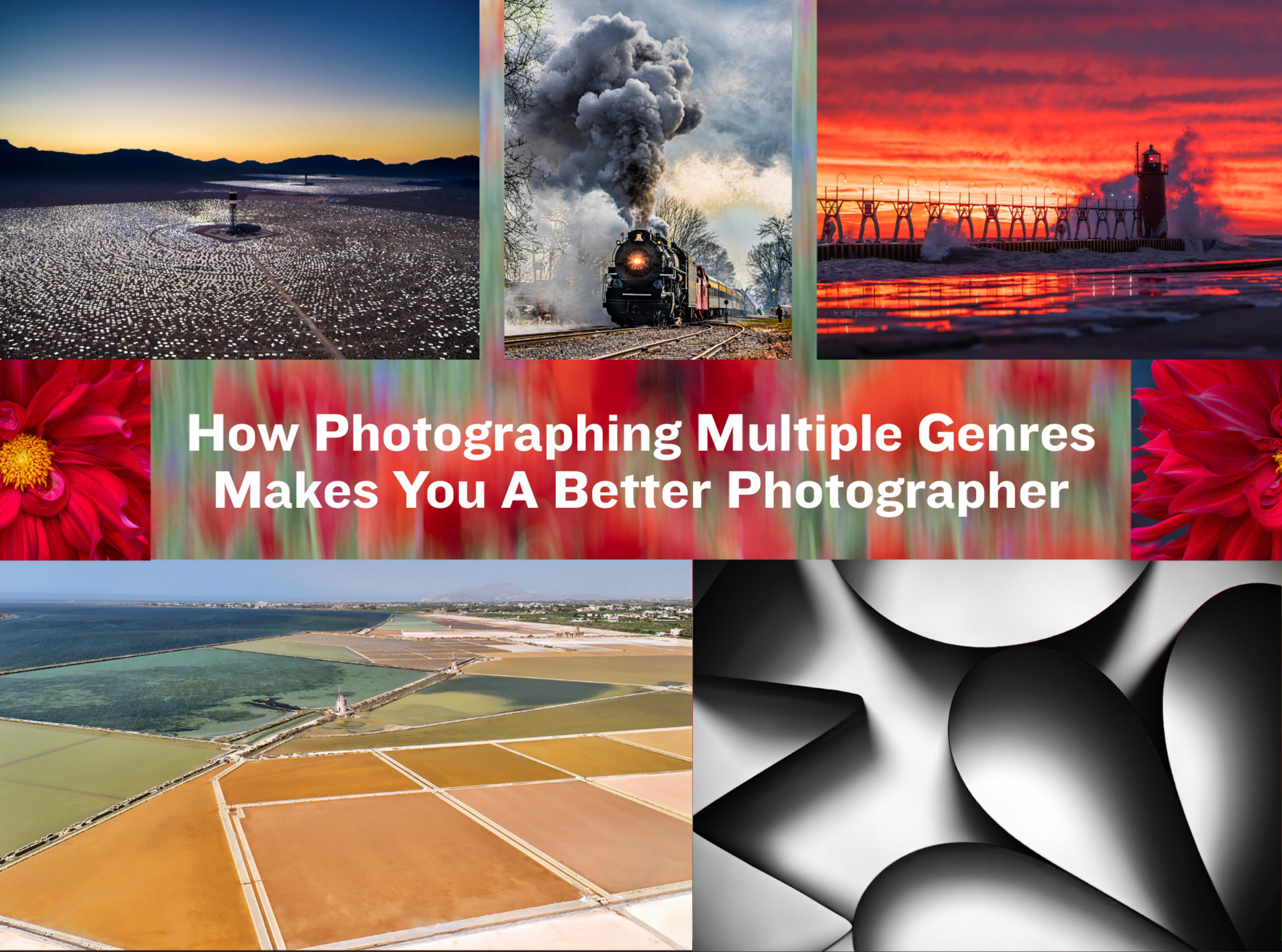
Does photographing multiple genres make you a better photographer? In today’s fast-scrolling, double-tapping world, photography and photographers often gets boxed into social media-defined categories. We see a moody landscape, a dreamy nightscape, a minimalist macro or wildlife in action and assume the artist only shoots that style.
That is, unless we take the time to look at their page, profile and website.

But the reality behind the scenes of micro-seconds of viewership on social, is often far richer than the scroll-by shows. Many strong photographers build their skills and artistic voice by exploring multiple genres of photography. Today’s blog shares 1) perspectives of seasoned, professional cross-genre photographers and how that strengthens their eye and ultimately their work; and 2) cross-genre techniques that help elevate work and workflow.
The reality for these and other multi-genre photographers – is that there eye, skill and imagery offer diversity. Their creativity, camera knowledge and post processing techniques are strengthened by their dynamic approach in their work.
“Photographing different genres isn’t about lacking focus; it’s about expanding your creative and technical range. Photographing multiple genres impacts so much in our work.”
Sheen Watkins
Photographers Perspectives on Photographing Multiple Genres
Applying that diversity makes a vast difference in their body of work. Instead of body of work, these multi-genre artists create bodies of work. Let’s take a look at the perspectives of three multi-genre photographers and how their approach shapes their creative eye. These three artists include: Kara E. Murphy, Brooke Ley and Karen Walter. Each of these three bring mastery, creativity and apply diversity of genres in their work. They drone, capture images in nature and landscapes, photograph wildlife, tackle creative photography and do specific project work for customers as a result of their diverse approach.
Kara E Murphy – Elevated Vision: Lighting, Mood & Tone
I started out photographing live musicians when I first picked up a camera. While it was exhilarating to capture some of my favorite artists, I found myself feeling limited after a few years. I was confined to certain angles, and many of my images began to resemble those taken by other photographers in the pit. That repetition pushed me to explore new perspectives—and eventually led me to aerial photography, where I’ve found my stride.
Even from above, though, I don’t stick to one genre. I enjoy creating abstract, landscape, and urban images, and that variety has made me more observant of my surroundings. I’ve learned to watch how light shifts throughout the day and how it transforms a scene, especially when capturing the same subject at sunrise, midday, and sunset. It’s made me more adaptable and inventive, always looking for new ways to interpret the world around me.

Working across multiple genres forces you to see differently.
It trains your eye and keeps your creativity sharp. For example, if I’m sitting at a coffee shop, I’ll observe how the sun hits a building across the street throughout the day. I study shadowplay from the ground and from the sky. I also follow photographers who inspire me and study how they use composition to tell a story. Right now, I’m especially drawn to the Liminal Photography group on Facebook. While it has nothing to do with aerial work, I’m fascinated by how people use tone and mood to elevate ordinary places into something dreamlike.

Living near the Grand Rapids Art Museum helps too. I visit when I need a spark of inspiration. David Hockney’s work is currently on display, and while he’s a painter, his bold, saturated use of color, especially how he evokes light and warmth, is something I plan on learning from and applying if possible.
Brooke Ley – Curiosity & Storytelling
As a photographer I don’t limit myself to just one genre. I’m drawn to whatever catches my eye: the dramatic skies of a lakeshore sunset, the delicate details of a flower or the cute head tilt of a beautiful bird. Over time, I’ve realized that working across multiple genres doesn’t dilute my photography, it strengthens it. Each subject stretches my ability as a photographer and often pushes me out of my comfort zone.
Macro photography sharpens my eye for detail. I notice the textures of petals, the tiniest insects, and the intricate patterns that might otherwise go unnoticed. Bird photography, on the other hand, teaches me patience and awareness, how to observe behavior, and even anticipate movement. Landscape work pushes me to find leading lines, balance and different compositions.

When one genre starts to feel routine, another often sparks new curiosity. After spending time focused on birds, I might shift gears and dive into landscapes or macro, and it helps keep my creativity refreshed. The change of pace keeps my work dynamic and enjoyable for me.

Photography is a constant learning process, and embracing a multi-genre approach has helped me grow not just as a photographer, but as a visual storyteller. For me, it’s not about choosing a lane, it’s about letting curiosity lead the way and allowing each genre to inform the next. That’s where the magic happens.
Karen Walter – Photographing Multiple Genres Energizes Creativity
Exploring multiple genres of photography has made me a more well-rounded and intentional photographer. Working across styles—whether it’s timelapse, macro, or ICM (intentional camera movement)—has pushed me to better understand the full range of my camera’s capabilities. “When you invest in quality gear, you want to use it as a true tool,” she says. “I’ve had so much fun really learning what my camera can do.” ICM, in particular, challenged me to see subjects in new and unexpected ways, embracing experimentation and even mistakes as part of the creative journey.

Macro photography, on the other hand, has sharpened my technical skills, like focus stacking, which is applied in landscape work to achieve sharpness from foreground to background. Multiple genres – from ICM, landscapes, flowers, pets and more – not only enhances technique but also keeps the process exciting and helps avoid creative burnout.

Photographing Multiple Genres – The Case for Variety in Photography
Tackling different genres isn’t about lacking focus; it’s about expanding your creative and technical range. Landscape, wildlife, portrait, street, macro, and documentary photography each bring their own unique demands. When you move between them, your skill set grows in unexpected and valuable ways.
For example, the patience and timing needed for bird photography can make you more observant and reactive when photographing people at action oriented events. Shooting landscapes teaches you to read light and weather, which becomes a powerful tool when planning environmental portraits or moody still-life scenes. Even dabbling in food or flat-lay photography can sharpen your composition and attention to the smallest of details.
Cross-Genre Techniques That Elevate Your Work
1. Planning Skills
Each genre calls for different types of planning. Landscape and wildlife photography require researching locations, understanding natural light, and tracking conditions. Portrait and event photography demand scheduling, location scouting, and understanding human dynamics. When you apply the logistical rigor from one to the other, you become more prepared and adaptive in every shoot.
2. On-Site Decision Making
Street photography trains your reflexes and helps you anticipate moments. That same instinct helps in fast-moving environments like weddings or sports. Similarly, the meticulousness of macro photography sharpens your eye for detail, which benefits product shoots or still-life setups.
3. Post-Processing Versatility
Editing a wildlife photo is different from retouching a senior portrait or color-grading a landscape. Working across genres introduces you to varied post-processing techniques, helping you refine your workflow and develop a signature editing styles that aren’t confined by subject matter.
Training Your Eye Across Contexts
The more varied your subjects, the more attuned your eye becomes to elements like light, composition, mood, and story. You start to see texture in feathers the same way you see texture in tree bark. You begin to frame human expressions with the same intentionality as you do a sunset. This cross-pollination of vision is where real artistry starts to emerge.

You also begin to understand that beauty exists beyond the “Instagrammable.” A rusted fence, the handsome, weathered face, a child’s hand grasping a dandelion, or the quiet intimacy of an abandoned trail becomes a worthy subject. You start creating not just for likes, but for the love of seeing.
Photographing Multiple Genres – The Social Media Illusion
On platforms like Instagram or Pinterest, photographers often feel pressured to stick to a single niche to build a recognizable brand. But this curated uniformity can hide or even hinder the photographer in maximizing their photographer artistry. Just because someone only posts dreamy landscapes doesn’t mean they aren’t equally skilled at editorial portraits or street scenes. Conversely, if someone posts only landscapes that doesn’t mean they have developed their eye and technical skills for other genres. Each photographer makes intentional choices about their art and what is right for them.
The other reality is that social media shows the highlight reel, not the practice hours. It’s easy to forget that some of the best shots come from experimentation, failure, and venturing outside your comfort zone. The discipline learned from one genre strengthens the intuition in another, even if the final image never makes it online.
Building a Unique Voice Through Diversity
In the end, what sets a photographer apart is not how well they replicate trends, rinse and repeat, but how clearly they can express a vision. Shooting multiple genres helps you build a visual vocabulary. You learn to translate emotion, light, and moment across different subjects, making your work unmistakably yours.
So if you’re stuck in a creative rut or feeling limited by your current niche, try branching out. Photograph wildlife if you never have. Shoot a street scene or a still life. Play with shadows, light, try a new lens, or edit in a different color grade. Every genre has something to teach you—and those lessons will only elevate your eye and your art.
Whether you’re sharing one genre online or keeping the rest tucked away in a personal archive, know that every shot, every experiment, and every challenge across genres is shaping you into a better photographer.
