
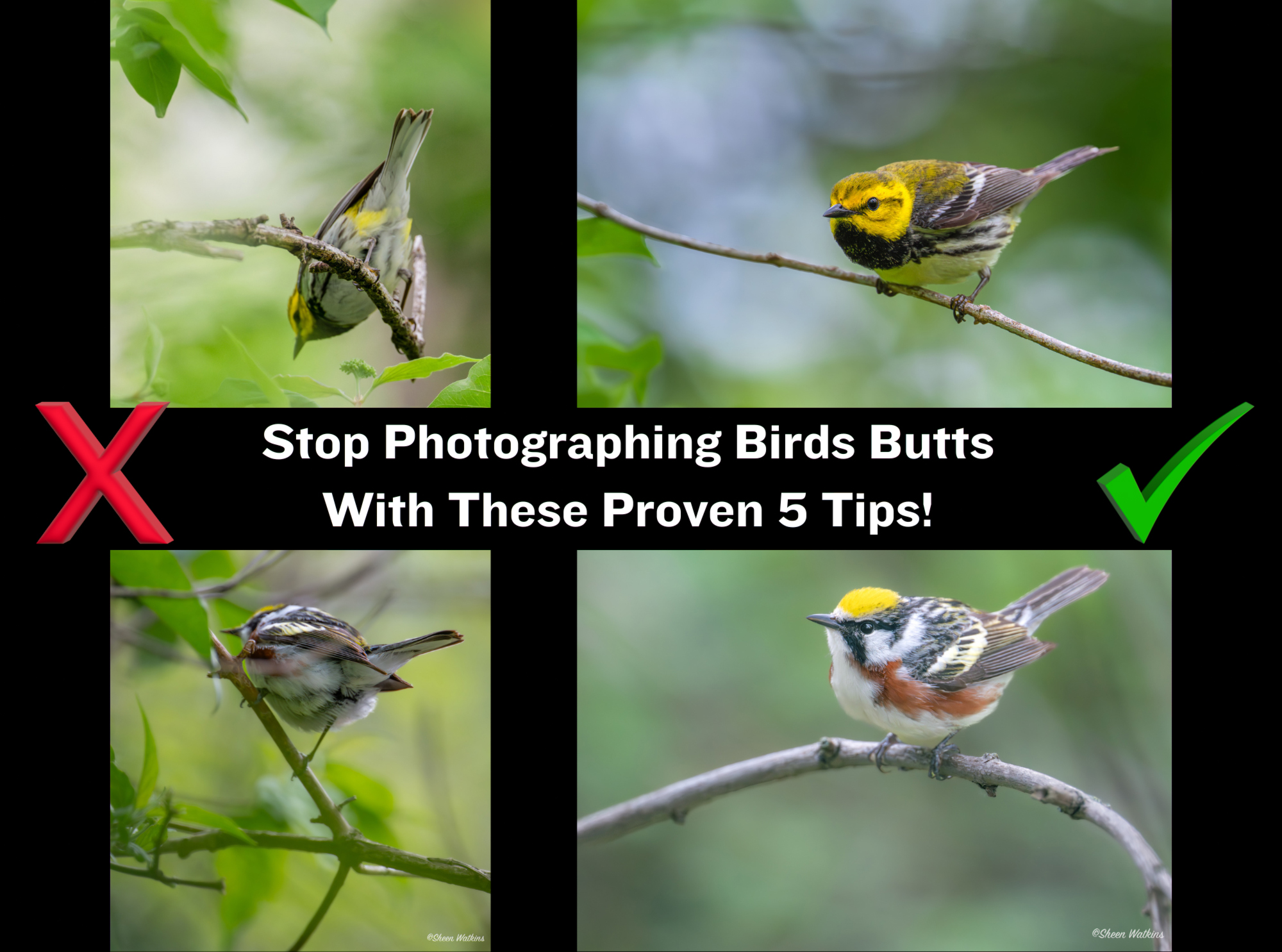
Let’s cut to the bird chase: if you’ve ever tried shooting birds, there’s probably quite a few images in your library from photographing birds butts. Maybe it’s a blur of tail feathers as a sparrow takes off, or the majestic rear end of a blue jay flying the wrong way. Hey, we’ve all been there. But don’t worry—you’re not alone in your feathery frustrations, and better yet, you’re not doomed to a future of backside bird portfolios. Note: Settings are included on all photos.

Note: This is part one of my bird photography series. This blog covers shooting techniques. A future blog will focus on bird artistry and composition in shooting and post processing.
If you’re ready to up your bird photography game and get more high-quality, social-media-worthy images (you know, the ones with eyes in focus and beaks facing you), here are five steps that help improve the ratio of good vs. bad butt images. Let’s swap many of those tailfeathers for tack-sharp eyes and dynamic poses—without losing the joy and silliness of the hobby we love.
Step 1: Camera Shooting Settings – Manual Mode is Your Friend in Photographing Birds
First things first—ditch auto, shutterspeed and/or even aperture mode. Manual mode gives you fast, creative control combined with control over the speed and that’s where the magic starts. Here’s a tried-and-true setup that keeps you ready to roll:
- Manual Mode – gives flexibility and fast control over your settings
- ISO: Set it to Auto. This lets your camera adjust sensitivity quickly based on available light. Our camera’s are smart! This one tactic gives us less one less element to focus on in the camera so we can hone in on our birds.
- Shutter Speed: Lock it in at 1/1600 (or faster!) to freeze those fluttery wings, especially with small, speedy birds like warblers or finches. For larger birds, wading birds I sometimes set the shutter to 1/1000 as they move slower.
- Aperture: Adjust this based on your bird’s size and distance. Shooting a hummingbird? Open that aperture wide (like f/4 to f/8). Got a heron or posing eagle? You can afford to step down a bit for more depth of field if bird is close. Try f/10 or even f/11 to get more detail of the bird in focus.
Birds don’t wait for you to fiddle with your dials. Set yourself up for success with quick, reliable settings so you’re ready when the magic happens. I keep my bird settings ready for ‘anything’ with a start off point of aperture set f/8, 1/1600 sec, ISO auto. Then if I want to change shutter speed, it’s the turn of the dial and my aperture stays where I want it. Or, if i choose to change my aperture, it’s a turn of the dial and my shutter speed stays where I need it to be. It’s also easy to change both if preferred. Easy peasy!
Step 2: Dial in the Right Focus Settings
Modern cameras are getting really smart. If you shoot with a newer model, learn the new features and use to your advantage. Many have bird-specific modes or wildlife subject detection and tracking. These are serious game-changers. When your camera can lock onto a bird’s eye like it’s got a vendetta against soft focus, you’re golden.

If you’re working with an older camera (awesome quality is based on the photographer first, gear second!), here’s a couple of tips:
- Use Single Point Focus or a Small Group Focus.
- Keep that focus point on the bird’s eye or head—not the belly, not the branch, not the neighboring squirrel (unless the squirrel’s doing something amazing, in which case…shoot your shot).
With mirrorless and DSLR technologies, leverage Continuous/Burst mode where the camera takes photographs continuously while the shutter-release button is pressed all the way down.
Practice tracking birds in flight by panning smoothly, and pre-focus on perches and distances where you anticipate action. A little preparation can mean a lot fewer blurry mystery blobs in your photos.
For a preview of my current and previous gear: My Gear
Step 3: Exposure Compensation – Keep it Simple
This one’s easy: set your exposure compensation to zero and go from there. Birds are often moving between light and shadow, so if your images are too dark or too blown out, tweak your compensation up or down slightly.
But generally? Zero is a good starting point. And if your camera has a histogram or highlight alert, use them for a quick inspection of your work! It’s okay to stop, inspect your work and adjust. They’re like your bird photography spirit guides that help prevent the “what if” moments when you load your images onto your computer.
Step 4: Know Your Subject when Photographing Birds – The Bird Brain Game
You don’t need a PhD in ornithology to get better shots—but a little knowledge goes a long way. Here’s a few examples.
- Warblers: Love insects and tend to hop around in trees. Think of them as tiny, caffeinated acrobats.
- Birds with Babies: Are laser-focused on finding protein—worms, bugs, midges… basically the bird version of protein shakes. Look for busy activity near nests.
- Robins and Thrushes: Ground foragers. Watch for the signature hop-hop-tilt-head move, then pounce!
- Swallows: Aerial masters. Good luck catching these in flight (hint: bright light and predictive autofocus help), but they’ll often return to the same wire, birdhouse or branch.
- Flycatchers: Perch-hunters. They’ll dart out, snag a snack mid-air, and return to the same or nearby spot. This is perfect for pre-focusing and waiting it out.
Understanding behavior lets you anticipate movement. And anticipation leads to timing. And timing leads to… not photographing birds’ butts.

Another commonly used tool these days is the free Birding App Merlin from Cornell Lab. Turn the app’s recorder on and images of the birds singing near you pop up. A great way to learn more about your bird, their song and calls, and where they are.
Step 5: Be Patient – It’s a Numbers Game (With a Dash of Luck)
Here’s a secret every nature photographer knows: for every stunner you see online—the sharp-eyed owl in golden light, the hummingbird with the perfect wing blur—there are probably a hundred rejects. Yes, we all arrive home with memory cards with misfires, missed focus, and yes, bird butts. Our goal is to minimized the latter and not see red when loading up our images.

If you’re feeling discouraged, don’t. By going out, working your subjects and developing your skills, you’re doing it right. Bird photography is part art, part science, and a whole lot of patience. Sometimes it’s a wait 45 minutes just for a warbler to give you the side-eye or full body view. Other times, blue jay will photobomb your shot while you’re trying to focus on a woodpecker. Go figure.
Bring snacks and water, dress for the weather, and let nature do its thing. The more time you spend observing, the more you’ll start predicting those perfect moments—and capturing them (without photographing birds’ butts).
Final Thoughts: From Butt Shots to Brilliance
Bird photography isn’t just about getting the “perfect shot.” It’s about being present, paying attention, and connecting with nature—even if your subject is facing the wrong way 80 – 90% of the time. When you treasure your subjects, it reflects in your work.
With a few tweaks to your technique, a little planning, and a lot of patience, your hit rate will improve. Start using manual mode with auto ISO, learn your camera’s focus settings, study your subjects, and embrace the waiting game.
And remember, all bird photographers including those on social, have a blooper reel of blurry wings, awkward landings, and yes, plenty of tailfeathers. So laugh it off, keep shooting, and celebrate the small wins—because even some of the best shots started with a bird flying the wrong way.
Now get out there, aim for the eyes, and let photographing birds’ butts be a thing of the past – most of the time.
Another blog that may be of interest: Photographing Hummingbirds in Natural Light
